

As the only student of a private Catholic grade school attending a Jewish summer camp, I would enter this annual environment without any ready-made friends. I’d spend the next two months loathing the camp’s many competitive physical activities, even the mundane ones like tetherball.
But there was a twice-daily activity I loved: swim time. The afternoon saw us engage in “free swim”, when we could leap into Spectacle Pond and splash around however we liked. I loved the feel of the lake bottom between my toes, then swimming out to the float, dangling my feet in the water while looking back at the shore — a measurable gulf between “here” and “there” that I’d traversed, giving me a sense of pride.

But one “there” I never made it to was the advanced swim group during the morning session’s instructional swim. I was placed in the beginner group, where we were taught to put our face in the water and blow bubbles, then go out to the pier, kneel with our hands clasped above us, and fall forward into the pond in what was supposed to be a dive.
None of those abstract lessons translated into anything I learned. Each successive summer, I was evaluated to see how far I’d come; and each summer, the assessment was the same: I still belonged in the beginner group. I never progressed beyond that.
Yet I can very much enjoy things I’m very bad at. I’ve never shied from the water, jumping into pools every chance I get. My ample ability to dog-paddle and tread water left me with little cause for concern — though it didn’t always look that way from the outside.
One rather telling moment came on a family trip to a water park. As I played in the wave pool, a lifeguard leaned over and concernedly asked, “Do you need help?”
“No,” I meekly replied. “… This is just how I swim.”

These experiences left me unsure if I could accurately say I even knew how to swim. That was something I wanted to change — but the life of a nomad makes it difficult to commit to a time and place to learn a new skill.
Fortunately, my recent stay in Burlington, Vermont, was a relatively lengthy six weeks. And the local YMCA — a new facility that just opened in January 2020 — just happened to have a six-week course of weekly swim lessons that aligned perfectly with my itinerary.
The proper gear
When I was eight years old, I started wearing glasses, which were easy to take off for a swim. A decade later, as my vision worsened and then stabilized, I switched to contacts, which generally stay in all day — and need to, lest I be unable to see.
This left me hesitant to put myself in a situation where my contacts could get lost or infected. If I went underwater but forget to close my eyes, would I still be able to see when I surface? Not knowing the answer to that, I found myself unwilling to dive or dunk or swim underwater; I could do little more than wade without risking my vision.
When I signed up for swim lessons, I asked what I would need, and I was told a pair of swim goggles would suffice. I bought a pair, and the first time I put them on in the pool, I felt them suction onto my face; would my eyes suffocate?? I shut my eyes and submerged myself — then, dubiously, I opened my eyes.
… I could see! I could see my hand in front of my face, the swimmers across the pool, the arrows under my feet that divided the lanes. And when I surfaced, I didn’t have to rub my eyes or worry about my contacts.
Goggles became a game changer. I could now focus on my swimming, courtesy a $30 investment that had relieved me of decades of concern. I’m embarrassed I didn’t think of it sooner.
Early assessment
When I registered for the class, I had to choose an experience level: beginner or intermediate. As the former seemed aimed more at those who were afraid of the water or didn’t know how to float in it, I opted for the latter.
Nonetheless, when I showed up to the first night of class, the first thing I proclaimed to the instructors, a husband and wife team: “I don’t know if I’m in the right class.” They assured me they’d figure that out soon enough.
Philip, who’d trained under Olympic swimmer Tom Malchow, took the more experienced of the intermediate swimmers, while Sheila took the rest. After I spent a half hour frantically paddling, Philip came over and asked his partner, “Is he in the right class?” Without hesitation, Sheila confirmed that I was.
Philip looked at me and confidently asserted: “You’re Kenough.”

Breathing is hard
I’ve had training in both singing and tai chi, two disparate disciplines that had one common lesson: breathe in through the nose; breathe out through the mouth. There are many important reasons why relying on the nose for intake of air is good for your health.
But none of those reasons apply when your face is underwater: if you’re not actively expelling air through your nose, then water is coming in, which is a discomforting and distracting experience (and one with the potential for a sinus infection). That means breathing while swimming needs to be backward: breathe out through the nose, then quickly come up for air through the mouth.
While reversing my usual breathing habit came easily, getting the rhythm down was something I never mastered. The front crawl swim stroke requires putting my head in the water, then surfacing to the side and gulping air before plunging back under — the same lesson I was supposed to have learned by blowing underwater bubbles at summer camp. Yet sometimes I was so focused on my strokes that I forgot to expel air underwater. Or I wouldn’t know whether to take a breath every two strokes or every three. Or I’d be crawling so fast that I wouldn’t leave myself enough time for a proper breath. Or I’d take too big a breath, or too small.
Philip said that if all that mattered was effort, I’d already be a pro. But instead, I was wasting energy and exhausting myself before I’d gotten very far.
Breathing became the focus of all my lessons. I tried practicing the rhythm of my breathing while simply standing in the pool. I tried swimming as slowly as possible, giving myself time to think through the next steps and execute them. I even went home and watched YouTube videos about how to swim.
I didn’t feel I was improving. Fortunately, my instructors and even my fellow classmates all said they saw me getting better. I needed that feedback, as I am my own worst critic.
Context breeds contempt
My voice teacher would’ve been disappointed if she’d known how little I practiced between sessions — which was not at all. I was committed to being a better student with swimming.
Well, it was a half-hearted commitment: my swim lessons were six consecutive Tuesdays, and on half of those, I took myself to the pool on Monday to practice, so that I wouldn’t show up to the next day’s lesson a week out of shape. It was a free-swim complement to the instructional swim.
I tried to go during the hours the front desk said the pool would be least busy: 10 AM – 4 PM. But even in those hours, I never had the pool to myself.
The pool was divided into four lanes, with the expectation that its occupants would be swimming back and forth across the length of each lane. The lane you belong in is determined by your speed; I stuck to the slow lane.
On these days, I didn’t have an instructor to model proper technique for me. Instead, I unabashedly watched the swimmers in the other lanes, who were too focused on their laps to notice or care if some awkward novice was staring at them. As I stood there up to my chest in water, I unconsciously found myself mimicking their motions. With my feet planted firmly beneath me, I wasn’t going anywhere — yet I nonetheless slowly put one hand out and pulled it toward me in a slow imitation of a front crawl. Despite being middle-aged, I couldn’t help but feel like a child or a puppy, watching and learning from an adult.

On one of those free-swim days, I ended up sharing the slow lane with a far more experienced swimmer. For fifteen uninterrupted minutes, he swam length after length. Whereas I’d been inspired by swimmers in the other lanes, having a swimmer in my lane made me feel inadequate — like my feeble and often aborted attempts to swim a single length were disruptive to his effortless strokes. He was no bully or showoff; my feelings of inadequacy originated entirely within. But it was enough to make me quit for the day and get out of the pool early.
It reminded me of the one time I did a Paint and Sip — which, with me being a teetotaler, was just a Paint. By the end of the night, as I looked at all the beautiful paintings my friends had made and the flawless original off which we’d based our work, I was disgusted with my own crass effort. I wanted to toss it in the garbage, never to see it again.
Instead, I brought it home — and, a few months later, I hung it on the wall. There, free of the context of other, “better” paintings, I grew to admire it and even be proud of it. It was the best and only thing I’d ever painted as an adult.
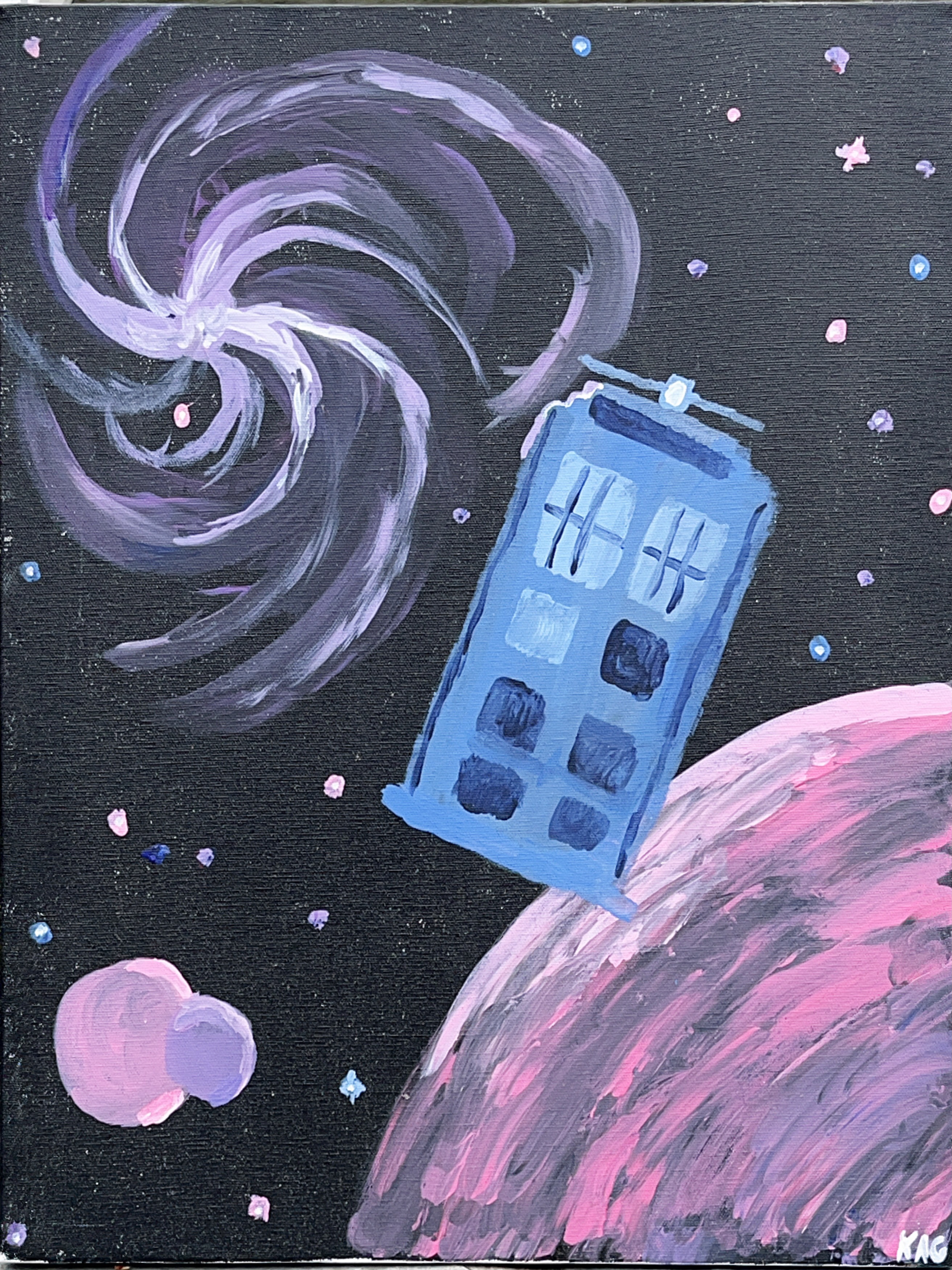
It’s a fine line between being inspired by others and judging ourselves by their standards; one is productive, and the other is not. Ultimately, all we can do is our best. We’re all works in progress.
Why bother?
In a phone call with my brother, when he asked what I’d been up to that evening, I offhandedly mentioned that I’d just gotten home from swimming. As this was news to him, he asked with sincere interest, “Why are you taking swim lessons?”
Without thinking about it, I replied, “I don’t like being bad at things.”
There’s some truth to that, but it’s not the whole truth, since there are plenty of things I’m perfectly okay being bad at. For example, I have no idea how to change my car’s oil or even how my engine works; automobiles are not a hobby of mine, and learning these things would be a chore with no payoff. Swimming is different in that I actually have fun in the water and look forward to the occasions. So it’s more accurate to say, “I don’t like being bad at things I enjoy.”
There’s an upper limit to that, too. My dad loved playing Tetris, but he rebuffed my offers of guide books and strategies for improving his game. When I was younger, I didn’t understand how he could not want to master something he enjoyed.
Now that I’m older, I better understand both my limits and the law of diminishing returns. I’ve always been pretty darn good at Tetris, and I still play it today — but I have no desire to compete with the pros. Similarly, I’ll cycle for a hundred miles at a time, but I still don’t know how to change a flat tire. And I love traveling, but I’d rather rent an Airbnb than outfit a van for all my needs. The complement to “I don’t like being bad at things I enjoy” is “I am satisfied being very good at things I enjoy — without necessarily being great at them.”
Nolan Bushnell, founder of Atari and Chuck E. Cheese, supposedly said that learning the last 10% of any skill is the hardest, but it’s what sets the true artisans apart from the amateurs — yet he would rather learn 90% of a skill, and then move on to learn 90% of another skill. I don’t know if I necessarily subscribe to that philosophy… but if I can learn 90% of what it takes to swim, then it will have all been worth it.
I can do it!
After I’d been taking lessons for awhile, I learned that only 46% of Americans can perform the five skills that constitute basic water competency:
- Step or jump into the water over your head.
- Return to the surface and float or tread water for one minute.
- Turn around in a full circle and find an exit.
- Swim 25 yards to the exit without stopping.
- Exit from the water. If in a pool, be able to exit without using the ladder.
Before I started lessons, I couldn’t do #4. Now I can swim the length of a non-Olympic pool — though don’t ask me to swim back.

I may have completed my six-week course, but there’s still more to be learned. According to one website:
For adults who learn at a normal rate and don’t have any fear of water, around 20–25 hours of private lessons is usually sufficient to gain basic swimming skills. That translates to about a year of one 30-minute lesson per week.
Alistair Mills, “How Long Does It Take to Learn to Swim?“
All my free and instructional swims at the YMCA added up to only about six hours total. I still have a long way to go — but at least I’ve made it the first 25 yards.

