
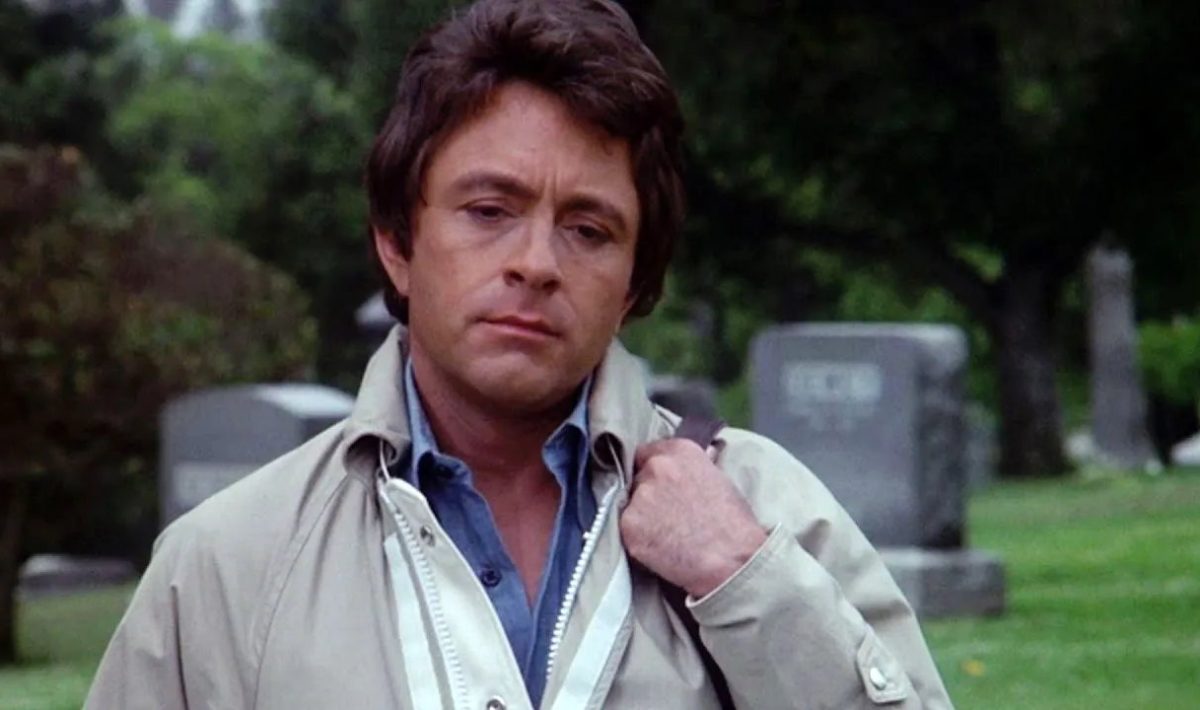
Of all the shows I watched as a kid in the 1980s, there were two that I watched with my parents. One was The Incredible Hulk, in which Bill Bixby played the scientist David Banner, who was believed to be dead. This misconception allowed him to anonymously wander the country, seeking a cure for his affliction: when angry, he turned into a green, muscle-bound monster who was wanted for a murder it hadn’t committed. Inevitably, Banner would find himself in a situation where he only he and his secret alter ego could help someone — a woman who’d been kidnapped, a child who was being abused. But in revealing himself, Banner would need to abandon the home he’d built for himself. Each episode ended with him walking away from the camera to the poignant piano tune “Lonely Man”.
The other show was Highway to Heaven, which was a bit less lonely. Jonathan Smith, an angel from Heaven (played by Michael Landon), accompanied by his mortal friend Mark Gordon (played by Victor French), wandered the country, helping those in need. And, just like how Banner had the strength of the Hulk behind him, Smith had the power of God.

I enjoyed how each episode of these two shows brought us into a new environment, with a new cast and rotating characters, the only points of continuity being one or two main characters. Similar to how Star Trek would later bring me to new worlds and new civilizations, I was eager to see where the monster and the angel would find themselves each week.
A decade later
By 1993, Bixby, Landon, and French had all passed away in their fifties — tragic endings for tragic characters. But with their series off the air, other shows took their place.
Quantum Leap had Sam Beckett (played by Scott Bakula) as a time traveler who jumped throughout America’s history, putting right what had once gone “wrong”. Although seemingly as altruistic as Highway to Heaven, the poignancy was that Beckett had no control over his leaps; his reward for each history-correcting episode was the chance that his next leap would be the leap home. Instead of a Hulk or God helping him, Beckett had a holographic projection of a futuristic companion who fed him information needed to complete each leap. The show was successful enough that a sequel ran two seasons, 2022–2024.

Vanishing Son is the only show on this list you haven’t heard of, yet it has a place in American television history as the first series to feature an attractive Asian protagonist. Russell Wong played Jian-Wa Chiang, a Chinese dissident who comes to the United States illegally. Similar to The Fugitive, Chiang is on the run for a murder he didn’t commit. In each episode, he simultaneously tries to find the actual killer, evade the FBI, and use his unparalleled martial arts to help the people he meets. The show ran for four made-for-TV movies, followed by a single season of 13 episodes as part of the “Action Pack” — the same programming block that introduced us to TekWar and Hercules: The Legendary Journeys. Vanishing Son was eventually cancelled to make room for the Hercules spinoff Xena: Warrior Princess.
I don’t know if there’s a name for the genre that encapsulates these four shows: Wandering hero? Tragic drifter? Whatever it’s called, it’s more common than this list implies: other series, from Sliders to even Dr. Who, sci-fi favorites of mine, could also fall into this category. Early Edition could be seen as similar to Highway to Heaven, and the short-lived Journeyman was inspired by Quantum Leap. Many other shows that extend before and after the two decades in which I was watching television have continued this tradition.
Revisiting Vanishing Son
I cut my cable in 2000 and didn’t start streaming my media until the pandemic of 2020; there are a lot of shows I haven’t seen or thought about in that time. But of all the shows mentioned above, I remained fixated on Vanishing Son — not necessarily because it was the best, but because it was the most elusive. Besides being the shortest-lived of these four series, it’s also the only one that never saw a home media release. Twelve of the thirteen episodes are teasingly listed with plot summaries on the NBC website; their acknowledgement confirms that I didn’t imagine the show. But the show’s index declares, “Episodes are currently unavailable.” Clicking through to any individual episode strongly reiterates: “SORRY, VIDEO IS NO LONGER AVAILABLE”
After waiting almost thirty years for some network to make Vanishing Son available in one form or another, I recently got my hands on a complete run of the movies and show. Rewatching it now, I’ve been fascinated to realize how many specific scenes or lines of dialogue I remember verbatim, despite not having seen the show since I was an impressionable teenager. It’s not just how imperturbable Russell Wong’s character is that left an impression on me — he never seems caught off-guard by anything — but also how value-driven he is. That’s true for all these shows’ heroes, but many of them are forced into their situations: David Banner wanted to live under everybody’s radar, but his uncontrollable rage forced him into precarious situations. Sam Beckett might’ve stopped leaping if he could’ve made it home. And Jonathan Smith was literally on a mission from God. For Jian-Wa Chiang, his quest to prove his innocence is very much a subplot that takes a backseat to his weekly journeys. Every chance he gets to run, avoid notice, and further his own quest, he ignores in favor of doing the next right thing.
Wandering nomad
A lot has changed since these shows first aired. I’m now watching Vanishing Son from the perspective not only of a middle-aged man, but of a digital nomad — and I’m startled by the similarities between the show’s genre and my life. Of course, the fantastical elements don’t apply: I don’t have super or divine powers, nor do I know the future or martial arts. The more tragic characteristics don’t apply, either: I’m not on the lam, and I’m not trying to get back home.
But each episode of my life does bring a new setting. One season of my show might be set in the American Midwest, trapped in Wisconsin during a pandemic; another season, I’m exploring the national parks of the Southwest while fostering dogs; then, in a series of themed episodes, I’m leaping from Hawaii to Australia to New Zealand. In each place, I meet new characters, from Martin the retrocomputing enthusiast in Pittsburgh to Biscuit the Dog in Golden. But I also love the surprise appearance of recurring characters. It could be Pam, the dog trainer I hadn’t seen in nine years; or Mike, the software developer I met only once before, 24 years earlier. These guest stars provide points of continuity in a story where otherwise the only consistency is the protagonist: me.
Someone on social media site reddit once asked, “What are the signs that you’re a side character in your own life?” One person answered, “Letting people have control over you — actions, decisions and emotions.” While I’m just as susceptible as anyone to having big feelings in reaction to other people’s behavior, it doesn’t steer the direction of my life. I’m not staying in one place because of a job or a person or an obligation; unlike Sam Beckett, I control each leap — even if there is no leap home in my future.
Another redditor offered an alternative answer to that same question: “Everyone’s the main character in their own show, but in the process you might see yourself as a passerby in other people’s show.” And that’s just as true for me as well. The main character is determined by whomever the camera follows. In Highway to Heaven, we never saw at length what someone’s life was like before Jonathan the Angel came into it, nor did we see how their lives persisted after they were changed by his presence. If the camera had followed the beneficiaries of his angelic influence, we would’ve seen Jonathan as just a passing stranger — the cowboy who cleaned up the town before moving on.
It’s been said that there are only two plots: a stranger rides into town; and a man goes on a journey. What rewatching Vanishing Son as a digital nomad has helped me realize is that these are the same story: it’s just a matter of perspective.
I’ll always be only a footnote in other people’s lives — someone who was here for a month and then gone. But, despite my lack of a tragic past or purely altruistic mission, I hope I’ve grown up to be like the wandering heroes I admired as a kid: someone who friends old and new are glad to see, and someone who leaves things a bit better than how he found them.

I know you are a dog person and now know that you like wandering hero shows. Put those two together and you have “The Littlest Hobo”:
https://en.wikipedia.org/wiki/The_Littlest_Hobo
It was on TV in Canada when I was young (pre-teen) and to be honest, I don’t think I ever watched a full episode. Even as a young boy, I found the show too campy and childish. But still, it is legendary with people my age in Canada.
Amazing! I’d heard of this show, but I didn’t know what it was about. I just started watching the first episode of the 1963 original series — and I’m hooked! 😄
I’m a big fan of The Incredible Hulk, Quantum Leap, and Vanishing Son! I’d also mention The Fugitive, Kung-Fu, and Knight Rider as examples of the wandering (semi-)loner TV trope. While it may seem corny to audiences accustomed to antiheroes, a true hero is someone who puts the greater good and helping others over their own needs. You’re also right to be master of your own destiny, and I look forward to catching up whenever your next leap takes you to New England….
Wow — someone else who knows Vanishing Son?! I thought I was the only one!! 🤯